Major Archaeological Discovery in Barcelona: Roman Forum Pavement Found Beneath Gran Hotel Barcino
SEO Title: Roman Forum of Barcino Discovered Beneath Gran Hotel Barcino in Barcelona
Slug: roman-forum-barcino-discovery-gran-hotel-barcino
Meta Description: Archaeologists uncovered a monumental Roman pavement from the forum of ancient Barcino beneath Gran Hotel Barcino in Barcelona. The site will be preserved and opened to the public.
Focus Keywords: Roman Barcino forum, Roman Barcelona archaeology, Gran Hotel Barcino excavation, Barcino forum discovery
Roman Forum Remains Discovered Beneath Gran Hotel Barcino
A remarkable archaeological discovery has recently been made in the historic center of Barcelona. During expansion works at the Gran Hotel Barcino, located at 3 Hèrcules Street, archaeologists uncovered a large stone pavement belonging to the forum of Roman Barcino, the central public square of the ancient Roman colony.
The remains, considered to be of exceptional historical and archaeological importance, have been carefully restored and prepared for public viewing. As part of the hotel’s renovation project, the archaeological site will be integrated into the building’s basement, allowing visitors to explore a unique fragment of ancient Barcelona beneath the modern city.
Interest in the discovery has been significant. A video documenting the excavation attracted 1,444 views during the week following its release on 24 February 2026, highlighting the public fascination with Barcelona’s Roman heritage.
Two Years of Archaeological Excavation
The discovery emerged during the expansion of the Gran Hotel Barcino within the historic Requesens House, a Gothic building dating from the 14th–15th centuries, located at 3 Hèrcules Street and 5 Arlet Street.
Archaeological investigations began in June 2023 and continued until July 2025, followed by conservation and musealization work.
The excavation was directed by archaeologist Jordi Amorós of AGER Arqueologia and supervised by the Barcelona Archaeology Service (ICUB) and the Cultural Heritage authorities of the Generalitat de Catalunya.
Originally, the intervention was intended to excavate a small 6-square-meter shaft for a new elevator foundation. However, the unexpected discovery of a flagstone pavement buried 2.5 meters below the surface transformed the project into a large-scale archaeological excavation.
Recognizing the importance of the find, the developer Grupo Gargallo expanded the excavation area from 6 m² to nearly 80 m², redesigning the construction project in order to preserve the remains.
The Roman Colony of Barcino
The city known today as Barcelona was founded as the Roman colony Iulia Augusta Faventia Paterna Barcino by Augustus between 15 and 10 BC.
The colony was established on Mons Tàber, a small hill near the Mediterranean coast that formed the center of the Roman settlement.
At the heart of Barcino stood the forum, the main public square where the political, religious, and administrative life of the colony took place.
The forum was located near today’s Plaça de Sant Jaume, at the intersection of the two main Roman streets:
- Cardo maximus, corresponding roughly to modern Llibreteria Street and Call Street
- Decumanus maximus, aligned with today’s Bishop Street, Ciutat Street, and Regomir Street
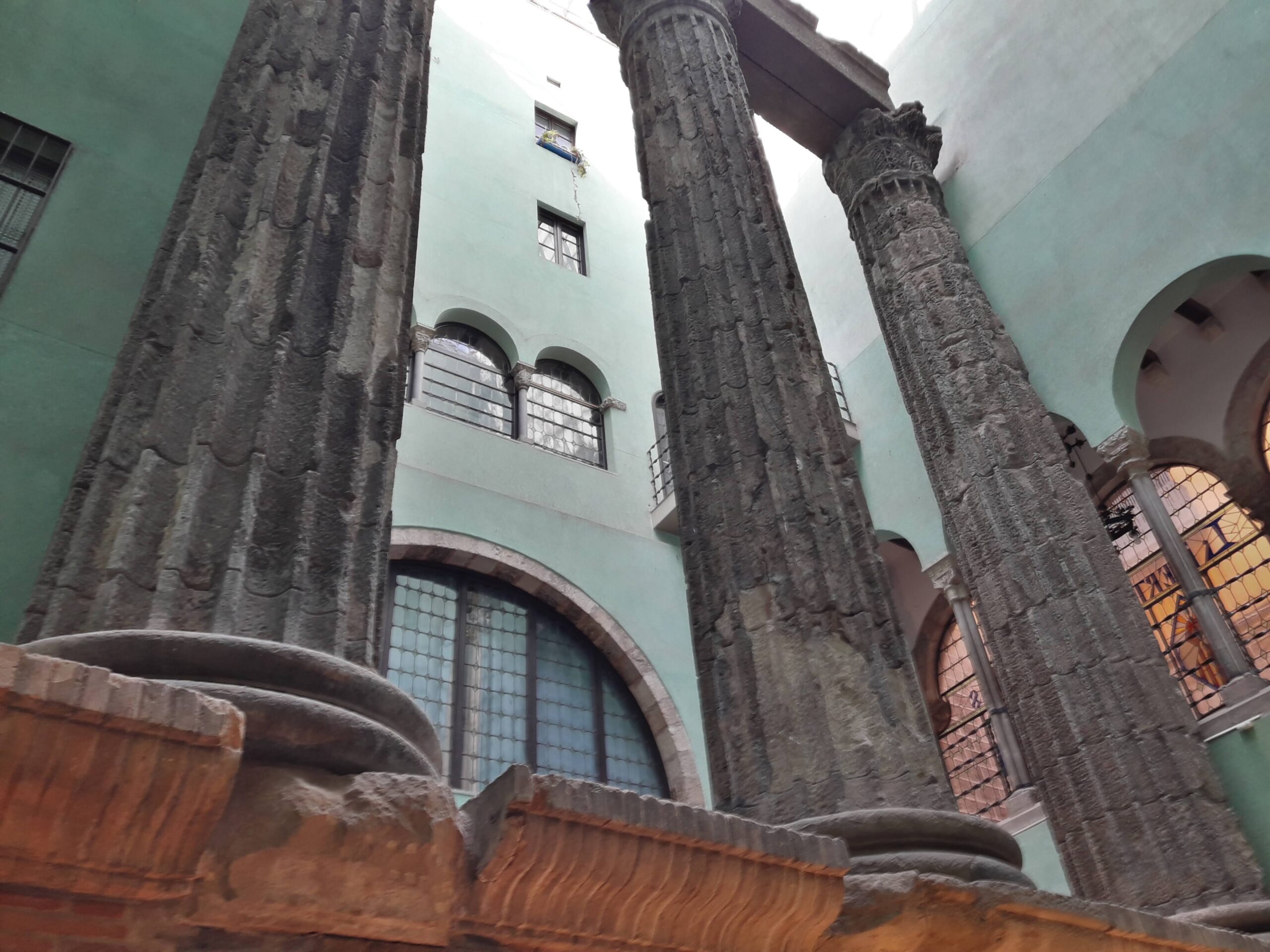
The forum area also contained the Temple of Augustus (Barcelona), the most important religious building of Roman Barcino. The temple’s podium and four monumental columns, each approximately 12 meters high, still survive today on Carrer del Paradís.
Until this discovery, these columns were the only visible architectural remains of the forum complex.
A Monumental Roman Pavement
The most striking feature uncovered during the excavation is a large Roman pavement covering approximately 42 square meters.
The surface is made of Montjuïc sandstone slabs, a material frequently used in Roman construction in Barcelona.
The slabs vary considerably in size:
- Width: 43–118 cm
- Length: up to 149 cm
- Thickness: 18–35 cm
They were carefully laid on the uneven geological substrate to create a durable surface.
The pavement is oriented northwest to southeast, meaning it runs parallel to the decumanus maximus and perpendicular to the cardo maximus, matching the original urban grid of Roman Barcino.
This is the first monumental paving of this type ever discovered in Barcelona, strongly suggesting that the remains belonged to the forum complex of the Roman colony.
Researchers are still investigating whether the pavement belonged to:
- an interior space of a public building, such as a legal or administrative hall, or
- an open public square within the forum.
Roman Hydraulic Infrastructure
Additional discoveries were made in the courtyard area of the building.
Archaeologists uncovered a large Roman concrete structure alongside a paved zone containing two square wells approximately 2.6 meters deep (equivalent to nine Roman feet).
The wells were connected by a siphon system, a device used in Roman engineering to regulate water flow using gravity and pressure.
Such hydraulic systems were typically used to:
- maintain water circulation
- clean reservoirs
- prevent stagnation
- control water distribution in fountains or basins
These findings suggest that the structure may have been part of a complex water management system within the forum, possibly associated with a monumental fountain or decorative water feature.
Imported Marble and Monumental Architecture
Excavations also revealed more than 150 fragments of imported marble, indicating the presence of richly decorated Roman buildings in the forum area.
The marble originated from several regions of the Roman world, including:
- Carrara in Italy
- mainland Greece
- Aegean islands
- Anatolia
- Egypt
These materials suggest that the forum of Barcino once featured monumental architecture decorated with high-quality imported stone.
Decline of the Forum in Late Antiquity
Evidence of spoliation—the removal and reuse of building materials—was found in the northeast part of the pavement.
Ceramic materials filling the gaps left by removed slabs indicate that the forum gradually lost its civic function during the early 5th century AD, a period associated with the decline of the Late Roman Empire.
Transformation During Late Antiquity
During the 6th and 7th centuries AD, the former forum area was reused for domestic structures, indicating a major transformation of the urban landscape.
Walls and floors discovered in the excavation show that the space was subdivided into smaller residential areas.
Two stone walls discovered in the courtyard suggest the presence of a street or passageway created during this period, aligned with the Paleochristian church of Saints Just and Pastor, built in the 6th century.
Medieval and Later Occupation
Archaeological layers from the High Middle Ages (8th–10th centuries) demonstrate further changes in land use.
Later strata correspond to the construction of the Gothic Requesens House during the 14th–15th centuries.
One notable medieval feature is a large cistern with a capacity of approximately 3,000 liters, located in the courtyard. The lower half of the structure was excavated directly into the Roman concrete foundation, while the upper section was built using masonry techniques typical of medieval cisterns.
A New Hypothesis About the Roman Forum
The discoveries at Hèrcules Street may significantly change historians’ understanding of the layout of the Roman forum of Barcino.
Previously, researchers believed the forum was oriented parallel to the cardo maximus, occupying much of the area around the Palau de la Generalitat and Plaça Sant Jaume.
However, the orientation of the newly discovered pavement suggests the forum may instead have been aligned with the decumanus maximus, implying a 90-degree rotation compared to earlier reconstructions.
This hypothesis could reshape our understanding of Roman urban planning in Barcelona.
Preserving Roman Heritage Beneath a Modern Hotel
One of the most remarkable aspects of the project is the decision by Grupo Gargallo to preserve the archaeological remains in situ.
Rather than removing the remains, the developers adapted the building design to incorporate the site into the hotel’s expansion.
This decision required significant investment and technical adjustments but ensures that the archaeological space will remain accessible to both residents and visitors.
A New Landmark for Understanding Roman Barcelona
The Hèrcules Street excavation represents a major contribution to the study of Roman Barcelona.
By revealing part of the forum and associated structures, the discovery provides valuable insight into the urban evolution of Barcino from Roman times through the Middle Ages.
Once fully accessible, the archaeological remains beneath the Gran Hotel Barcino will become an important new landmark for understanding the origins of Barcelona and the development of the ancient Roman city.
If you want, I can also turn this into a perfect WordPress post with:
- image placements
- SEO schema markup
- internal linking suggestions
- 6–8 license-free archaeological images
- optimized headings for Google Discover.
) were pretty keen on the find, so Grup Gargallo decided to expand the excavation area from 6m2 to 80m2 and adapt the work to ensure the preservation of the remains. They’ve also decided to integrate them into the building’s basement for public visitation, all under the advice and management of the competent archaeological authority.
Then, between May and July 2024, we did some structural consolidation work on the Requesens house, using 70 micropiles to safely excavate the whole of the Great Hall where the floor had been.
The excavation of the Great Hall was finished between February and July 2025, and work was also done in the courtyard of the Gothic house, where new archaeological remains related to the forum were uncovered, as well as from later periods. This was followed by the musealisation of the remains for public viewing, which has been going on from September 2025 to the present.
Here’s what we found:
The most impressive feature is a big pavement made of Montjuïc stone slabs, dating back to the colony’s founding period (15-10 BC), which covers 42 m² and is located almost entirely in the Great Hall, which is now on public display.
The slabs vary in width from 43 cm to 118 cm and in length up to 149 cm, with a thickness of between 18 and 35 cm, to adapt to the uneven surface of the geological substrate.
The pavement is laid out in courses from northwest to southeast, which is perpendicular to the cardo and parallel to the decumanus. This matches the original urban grid of Barcino. This is the first time paving like this has been found in the city, so it’s been linked to the space of the Roman colony of Barcino’s forum.
We’re still figuring out if the pavement matches the inside of a public forum building, like a political, legal, religious or commercial building, or if it’s the outdoor space of a public square.
To the southeast of the pavement, you can see a huge Roman concrete structure in the hotel courtyard.
Next to it is a paved area with two square wells 2.6 meters deep (9 Roman feet), connected to each other by a siphon. The study of the ceramic materials used in the wells shows that they were last used around the middle of the 6th century AD.
A siphon is basically a tool that lets water move from one place to another by using the forces of pressure and gravity. In Roman times, they used this method to control the flow of water, clean reservoirs, make sure there was always water moving and stop things from getting too smelly or sitting still. This suggests that these wells weren’t just simple cuts in the ground, but part of a more complex hydraulic system, possibly connected to a decorative fountain or to managing water in the forum area. It’s possible that this Roman concrete structure, looted in antiquity, was covered with marble elements or slabs, given that more than 150 fragments of imported marbles have been found in the excavation – Carrara, continental Greece, the Greek islands of the Aegean, Anatolia, or Egypt, among others.
The forum’s paving shows significant spoliation at the northeast end, which is a very common phenomenon in constructions from the High Imperial period (1st–3rd centuries AD). Often, slabs and blocks of stone were removed in later eras to be reused in new buildings. The ceramic materials that fill the gaps left by these spoliations help us to date the loss of civic function and the gradual abandonment of the public square to the early 5th century AD, a period marked by the crisis of the Late Empire (4th–5th centuries AD).
So, the Roman admin structures didn’t really pan out, and then the Visigoths showed up in Catalonia.
In the 6th and 7th centuries AD, several walls and floors appeared in the Great Hall, showing that the forum space was used in a more compartmentalised and domestic way.
In the courtyard, which was built directly on the old concrete structure, you can see two stone walls with lime mortar. They’re parallel and two metres apart, and tilted at 14.5° from the old flagstone pavement. This suggests there was an ancient passage or street there, which matches the urban reorganization that took place between the 6th and 7th centuries. Its alignment is similar to the Paleochristian church of Saints Just and Pastor, which was built in the 6th century, and you can still see part of the lobed apse today under the current Gothic church—the same Street of Hercules.
From here, we move on to the High Middle Ages (8th–10th centuries AD), when new changes are recorded that show a very different use from that of the square in Roman times. We’ve also found out about the archaeological levels from when the Gothic building was built (14th–15th centuries), as well as later modern and contemporary renovations. From this time, the medieval cistern in the courtyard of the Gothic house is definitely worth a mention. It can hold 3,000 litres, and the lower half of it was dug into the ancient Roman concrete structure, while the top half has a masonry construction system, similar to the medieval cisterns of the Domus of Saint Honoré. This granary must have been the Gothic house’s main grain storage until the courtyard was remodelled at some point in the modern era.
While they were digging, they found a lot of imported ceramics and 58 coins, which, along with the marble, show just how unique and impressive the space was and how it had been used over a long period of time. We’re currently studying all of these materials.
—New Hypothesis—
The results from Hercules 3 mean we have to rethink the usual idea of how the forum was oriented (see Figure 1). Until now, we thought the forum was next to the cardo maximus, taking up a lot of the space in the Generalitat Palace and Plaça Sant Jaume.
The dig data shows that the orientation is now very similar to the decumanus maximus, which is basically a 90° rotation. This matches the orientation of the documented pavement and its central position within Roman Barcino. This new way of looking at things helps us understand better how the ancient city’s public spaces were laid out, and opens up new ways to study the way the city was built (see Figure 2).
But this proposal for changing the forum doesn’t say anything about whether the Temple of Augustus, which is in the same forum area, would follow this rotation or keep its traditional position. This part isn’t mentioned in the press release and we’ll have to wait and see if future research looks into it.
The Hercules 3 project is a big deal for studying Barcelona’s Roman past, and it shows how important archaeology is for protecting a heritage that’s the only way to understand the ancient city before it’s gone for good. These kinds of projects, which are often decided based on the speed of public and private construction, are really important for finding new remains and adding them to the city’s historical story, like we’ve seen here. It’s also really impressive that the property owner, Grupo Gargallo, has promised to keep the remains exactly where they are, change the building design and encourage people to visit. This is a pretty unusual decision for the private sector because of the investment, technical constraints and impact on construction schedules, but it’s made it possible to recover a unique archaeological space that’ll stay accessible to citizens and visitors. The complex has been integrated into the hotel’s expansion and will become a new landmark for understanding the origin and urban evolution of Roman Barcelona.”